Terracotta Art of India: Ancient Origins, Regional Traditions & Living Craft
Explore India’s terracotta art heritage: from Indus Valley seals and Bankura horses to Molela hollow relief, Ayyanar shrines, and ancient temple architecture.
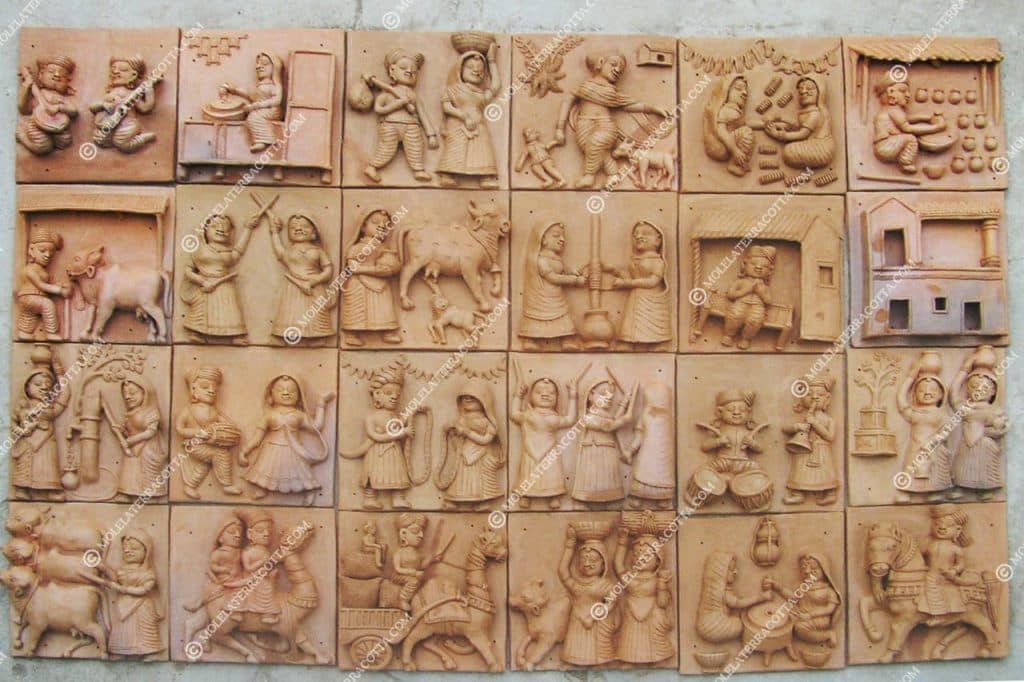
The Living Earth: Five Millennia of Indian Terracotta Art
Terracotta art—derived from the Latin terra cotta meaning "baked earth"—is one of India’s oldest, most resilient living artistic traditions, spanning over 5,000 years. Known classically in Sanskrit as *mrinshilp (sculpture from earth) or colloquially as mitti ki kala*, it represents humanity’s intimate dialogue with the soil. Unlike stone sculpture or bronze casting, which historically required royal courts and wealthy patrons, terracotta has always belonged to the common people, shaping daily domestic vessels, devotional votive figures, architectural ornaments, and tribal deities.
In Indian philosophical thought, clay holds sacred status as a manifestation of the Panchamahabhuta (the five primal cosmic elements): *earth (prithvi) forms its body, water (jal) gives it plasticity, air (vayu) dries its form, fire (agni) solidifies its spirit in the kiln, and ether (akash)* provides the hollow space within. From humble village hearths to grand temple facades, clay embodies an unbroken continuum between ancient craftsmanship and contemporary creative expression.
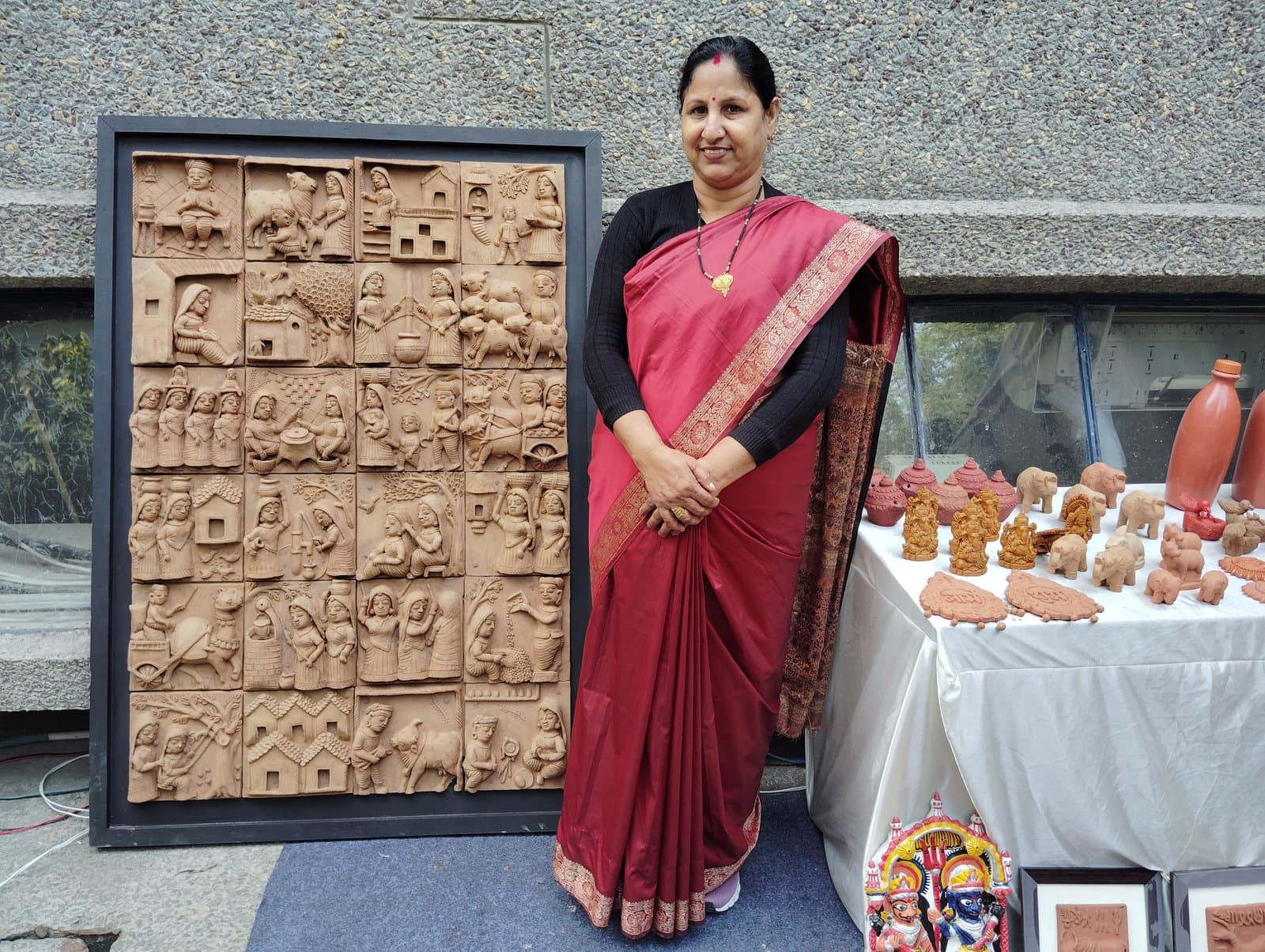
Antiquity: The Indus Valley & Harappan Civilization (2500–1500 BCE)
The earliest chapters of Indian terracotta art unfolded in the fertile plains of the Indus Valley Civilisation across major archaeological sites including Mohenjo-daro, Harappa, Kalibangan, and Lothal. Long before iron tools or classical marble carving, Harappan potters demonstrated extraordinary ceramic mastery, engineering both utilitarian wheel-turned storage jars and symbolic ritual artifacts.
Among the most celebrated relics are the hand-modelled Mother Goddess figurines, adorned with elaborate fan-shaped headdresses, miniature ear ornaments, and layered beaded necklaces—celebrating fertility, nature, and female divinity. Harappan merchants used intricately incised terracotta seals featuring the unicorn bull, humped zebu, tiger, and elephant for trade authentication, bearing an undeciphered script that continues to captivate historians.
Remarkably, clay also enriched everyday domestic life. Excavations have unearthed terracotta toy carts with rotating wheels, whistling clay birds, articulated animal figures, and miniature cooking stoves—testament to an ancient society where craftsmanship touched sacred rites and playful childhood with equal warmth.
Regional Terracotta Traditions: India’s Geographic Tapestry
India’s geographical and cultural diversity has given rise to distinct regional terracotta styles, each defined by local clay deposits, indigenous firing methods, and deep community folklore:
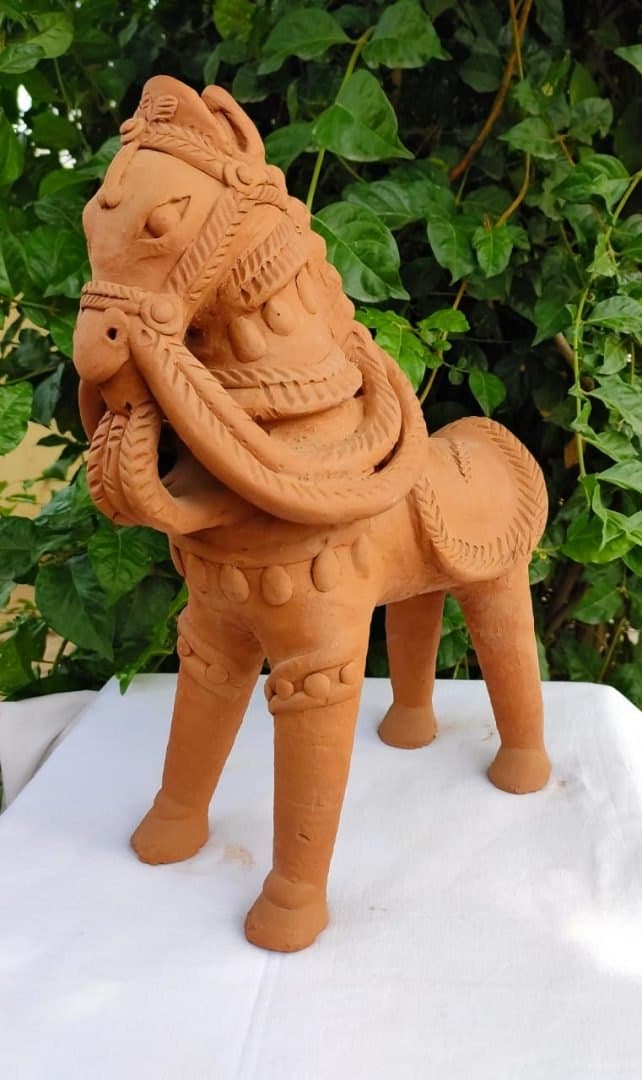
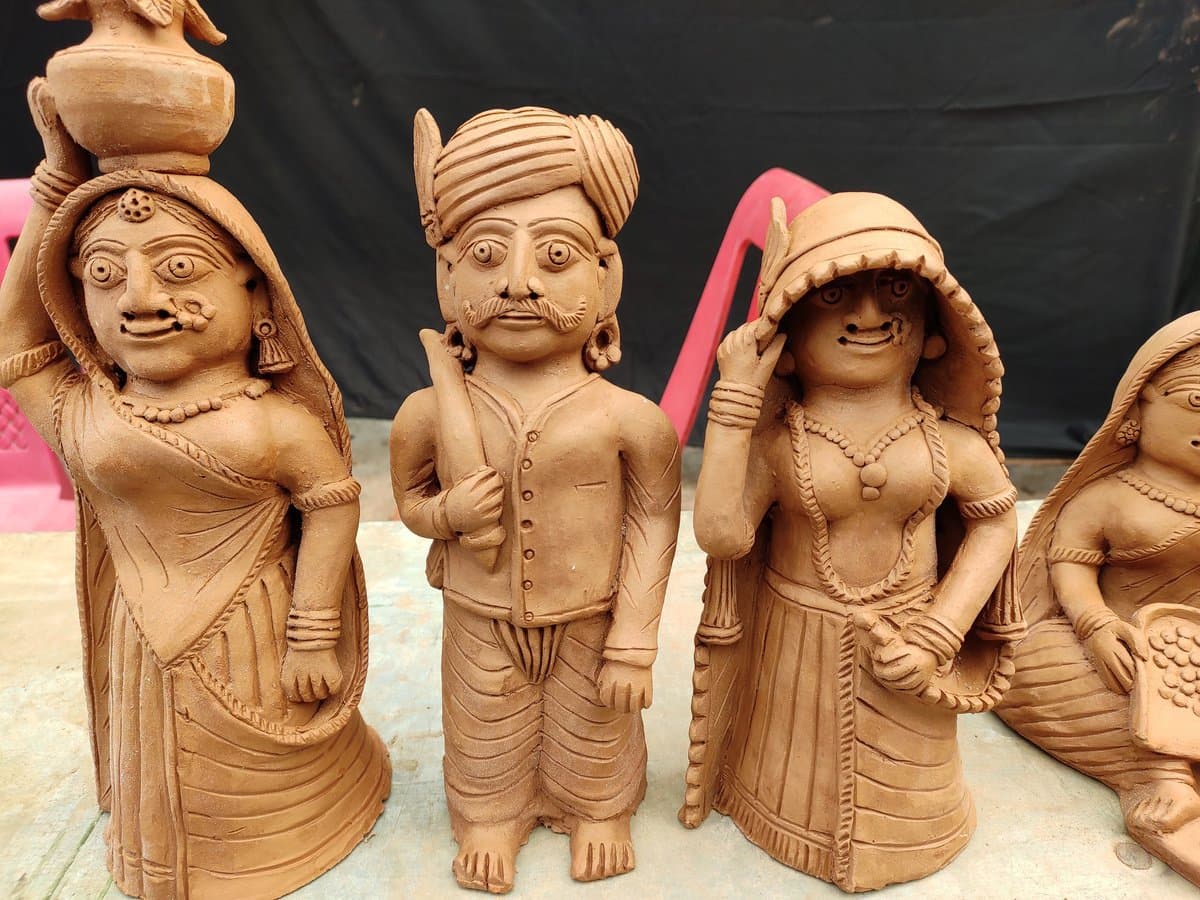
- West Bengal (Bankura & Bishnupur): Renowned worldwide for the iconic Bankura Horse crafted in Panchmura village, celebrated for its dramatically elongated neck, erect pointed ears, and symmetrical applique ornaments. In nearby Bishnupur, 17th-century Malla rulers commissioned magnificent brick temples (such as Madan Mohan and Jor Bangla) covered in thousands of carved terracotta relief panels depicting the Ramayana, Mahabharata, and Krishna Leela.
- Rajasthan (Molela, Rajsamand): Famous for its GI-tagged (GI No. 67) hollow-relief votive plaques. Hereditary Kumhar artisans sculpt sacred plaques of Lord Devnarayan, Bhairav Ji, and Chamunda Mata entirely by hand without moulds (saancha) or wheels (chak), using alluvial Banas river silt tempered with donkey dung (detailed in our Molela clay work process guide).
- Tamil Nadu (Ayyanar Shrines): Village shrines across Tamil Nadu feature colossal terracotta horses—often towering 10 to 15 feet high—handcrafted by the Velar potter community. These majestic horses stand guard at village borders as celestial steeds for Ayyanar, the guardian folk deity who rides through the night to protect villagers from evil spirits.
- Uttar Pradesh (Gorakhpur & Bhitargaon): Gorakhpur is famed for its GI-tagged ornamental terracotta elephants, horses, and multi-tiered decorative lamps crafted with intricate open-cut (jali) carving. Near Kanpur, the 5th–6th century Gupta-era Bhitargaon Temple remains one of the oldest surviving terracotta brick temples in northern India.
- Gujarat (Gundiyali, Kutch): Craftsmen in Kutch turn fine clay on the potter’s wheel to create polished earthenware painted with geometric, fish, and floral motifs using natural red ochre (geru) and black manganese (dhau), closely echoing 4,000-year-old Harappan pottery techniques.
- Odisha & Bihar: Tribal artisans in Odisha hand-model votive animal figurines, roofing finials, and ritual grain storage vessels. In Bihar, Darbhanga potters are famous for their vibrantly painted terracotta horses gifted during wedding rituals and folk festivals.
Hand-Sculpting, Wheel-Throwing & Moulds: Three Distinct Disciplines
While the term "terracotta" is often applied broadly, traditional Indian clay craft encompasses three distinct technical disciplines, each requiring specialised skills and serving different functions:
- Wheel-Thrown Pottery (Chak): The potter’s wheel is used primarily for rotational symmetry—shaping spherical water pots (matkas), cooling flasks (surahis), bowls (kullads), and festival oil lamps (diyas*). The speed of the wheel allows rapid, uniform production of everyday domestic earthenware.
- Mould-Pressed Terracotta (Saancha):* Widely adopted from the 1st century BCE (Shunga and Kushan eras) onwards, open-face or two-piece terracotta moulds enabled artisans to mass-produce decorative plaques, architectural bricks, and small religious medallions with identical details.
- 100% Hand-Sculpted Hollow-Relief (The Molela Tradition): The rarest and most labour-intensive discipline. In Molela, artisans reject both moulds and wheels. Slabs are flattened with a wooden mallet (pindi), sculpted additively by hand using the chisel-knife stylus (bhaldi), and hollowed from behind (see the complete eight-stage process). This ensures uniform wall thickness (1.5–2 cm), drastically reduces weight, and guarantees that every single artwork is completely unique.
The Indigenous Kiln: Firing in the Traditional Bhatti
The crucial crucible of Indian terracotta is the open pit kiln, known colloquially as the bhatti. Unlike modern electric or gas kilns with digital thermostats, the indigenous bhatti relies entirely on the potter’s empirical knowledge of flame, airflow, and biomass combustion.
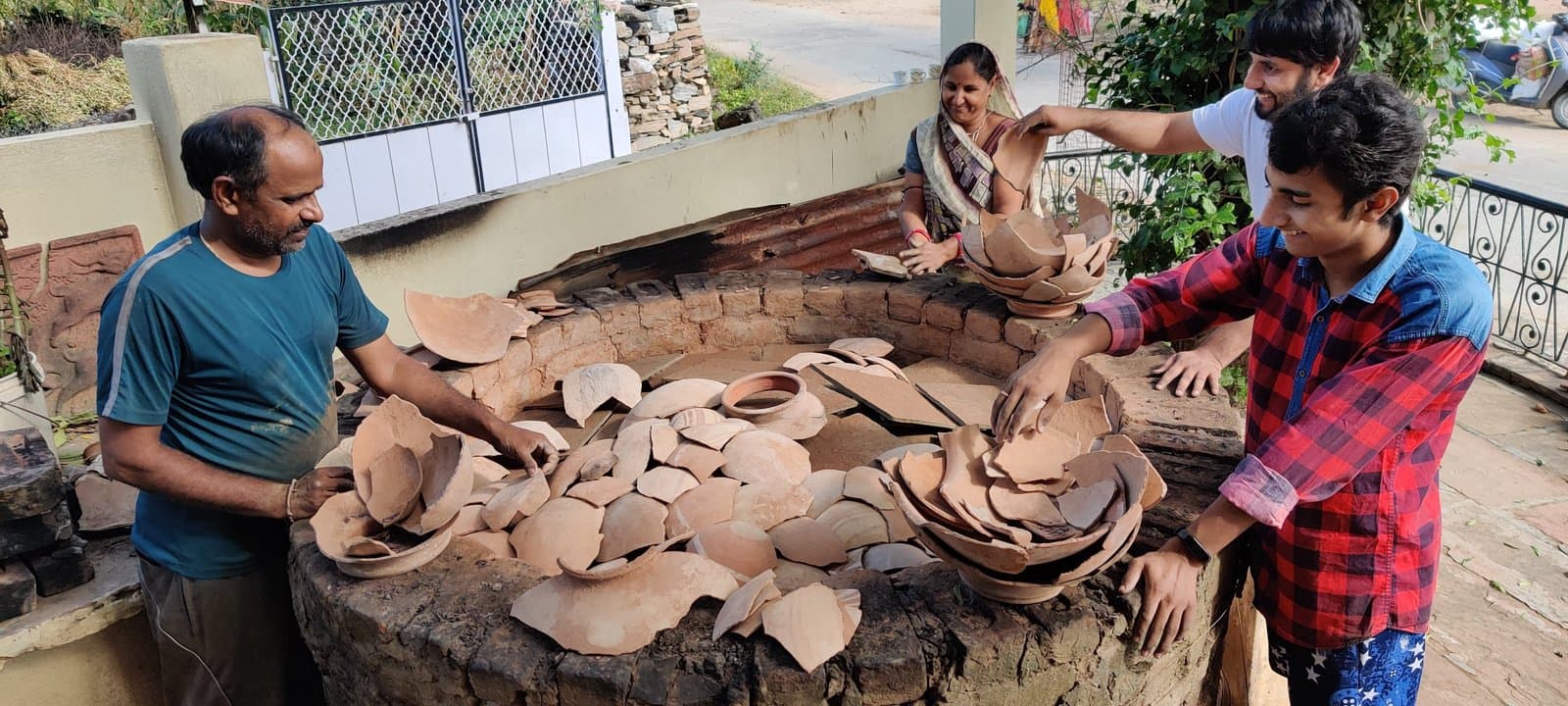
Bone-dry terracotta panels, figurines, and pots are carefully stacked in a circular pit or above-ground kiln structure. The wares are cushioned with layers of dried cow dung cakes (kande), local firewood, and rice husk. To trap heat and maintain an even thermal atmosphere, the mound is blanketed with hundreds of curved pottery shards (thikri) and sealed with a slurry of damp clay.
Fired for 12 to 14 hours at temperatures reaching 800°C to 900°C, the iron minerals naturally present in the river silt oxidise, yielding the signature warm, earthy terracotta-red tone. If the kiln is completely sealed to create a reducing (oxygen-deprived) atmosphere, the clay emerges in a striking smoked-black finish (kala terracotta), a technique perfected in Nizamabad and parts of western India.
Architectural Terracotta & The Modern Renaissance
From the 6th-century Gupta Dynasty temple at Bhitargaon to the 17th-century terracotta wonder of Bishnupur, clay has a storied history in Indian architecture. Long before synthetic building materials, terracotta served as a durable, weather-resistant, and aesthetically rich medium for exterior facades and ornamental lintels.
In contemporary design, Indian terracotta is experiencing a dynamic renaissance. Architects and interior designers worldwide are turning to terracotta wall decor tiles, curated theme sets, and custom architectural murals as sustainable, zero-carbon, and biophilic design elements that connect modern spaces to the earth.
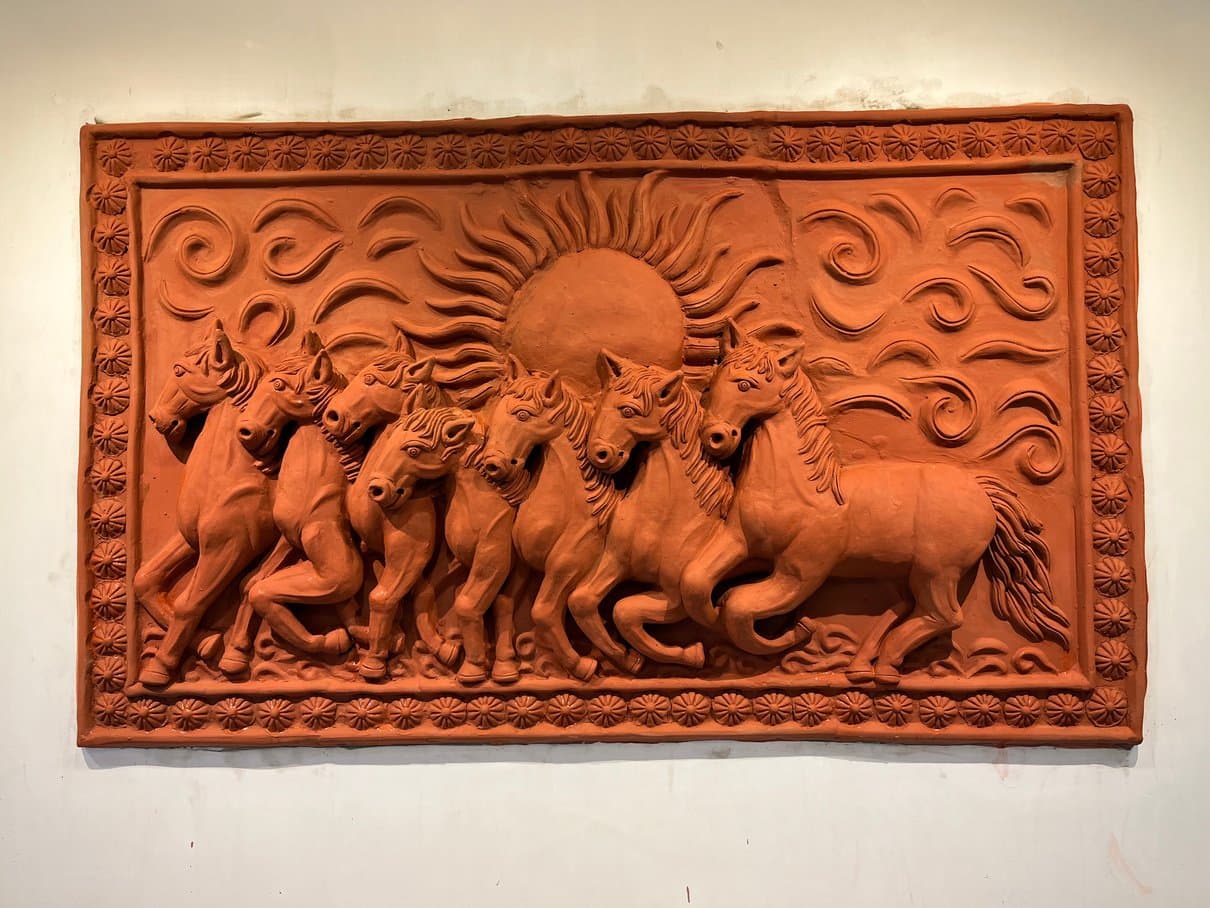
National Awardee Dinesh Chandra Kumhar, Kailash Devi, and their family in Molela have spearheaded this transition. By scaling traditional modular terracotta tiles into monumental wall murals measuring 10 to 50 feet, they have brought the timeless narrative of Indian village life, the Seven Horses of Surya, and sacred folklore into world-class luxury hotels, corporate headquarters, private residences, and international airports.
Frequently Asked Questions
Questions & Answers about Molela Clay Work
Key insights into the sacred origin, traditional techniques, and cultural significance of Molela terracotta.
What is the history of terracotta art in India?
Terracotta art in India has an unbroken history of over 5,000 years, dating back to the Indus Valley Civilisation (2500 BCE). Archaeological excavations at Mohenjo-daro and Harappa revealed terracotta seals, Mother Goddess idols, animal figurines, and toy carts. The craft evolved through the Mauryan, Shunga, Gupta (Bhitargaon temple), and medieval periods (Bishnupur temples), continuing today in vibrant craft clusters across Rajasthan, West Bengal, Tamil Nadu, Uttar Pradesh, and Gujarat.
What are the most famous regional terracotta styles in India?
India features diverse regional terracotta traditions: (1) Molela Terracotta (Rajasthan, GI No. 67): Hand-sculpted hollow-relief deity plaques and murals made from Banas river silt without moulds; (2) Bankura & Bishnupur (West Bengal): The iconic long-necked Bankura horse and 17th-century temple relief panels; (3) Ayyanar Terracotta (Tamil Nadu): Monumental 10–15 foot protective horses at village shrines; (4) Gorakhpur Terracotta (Uttar Pradesh, GI tagged): Intricate open-cut ornamental elephants and bells; (5) Gundiyali Pottery (Gujarat): Polished, painted earthenware echoing Harappan geometric patterns.
How does Molela terracotta differ from other Indian terracotta crafts?
Unlike most Indian terracotta crafts that rely on the potter’s wheel (chak) or repetitive casting moulds (saancha), Molela clay work is 100% hand-sculpted in hollow relief. Artisans sculpt figures additively on a flat slab using the bhaldi stylus, then scoop out the clay from behind. This hollow backing prevents cracking during firing, reduces panel weight by 40%, and ensures every piece is an original, non-replicated work of art.
Why is the horse such a prominent motif in Indian terracotta art?
In Indian folklore and tribal mythology, the horse symbolizes speed, vitality, solar energy (Surya Rath), and divine protection. In Tamil Nadu, giant terracotta horses are gifted to Ayyanar as celestial mounts to patrol village boundaries. In West Bengal, the Bankura horse represents devotion to Dharma Thakur. In Rajasthan, equestrian folk heroes like Lord Devnarayan (Dharmraj Ji) and Ramdevji are venerated on horseback for safeguarding rural communities and pastoral herds.
How are terracotta sculptures fired in traditional Indian kilns?
Sculptures are fired in an indigenous open-pit kiln called a bhatti. Bone-dry clay pieces are stacked vertically in a circular pit, cushioned with dried cow dung cakes (kande), firewood, and rice husk, and covered with broken pottery shards (thikri) and wet clay. Fired for 12 to 14 hours at 800°C–900°C, the natural iron in the clay oxidises to create the classic terracotta-red finish.
Is traditional Indian terracotta durable and suitable for modern architectural projects?
Yes. When properly fired at 800°C–900°C, terracotta is highly durable, weather-resistant, and chemically inert. In modern architecture, terracotta is celebrated as an eco-friendly, zero-carbon, breathable building material. Custom modular murals (such as 18" × 18" panels) crafted by master potters like Dinesh Chandra Kumhar can be installed on both interior feature walls and exterior building facades with standard tile adhesives.
Want a piece in this style?
Every plaque and mural is made to order in the size you need. Send a reference or a wall measurement and we will quote for it.